Bitcoin (BTC) analysis
Latest read: 2026-07-27 · updated every session · Last updated: July 2026
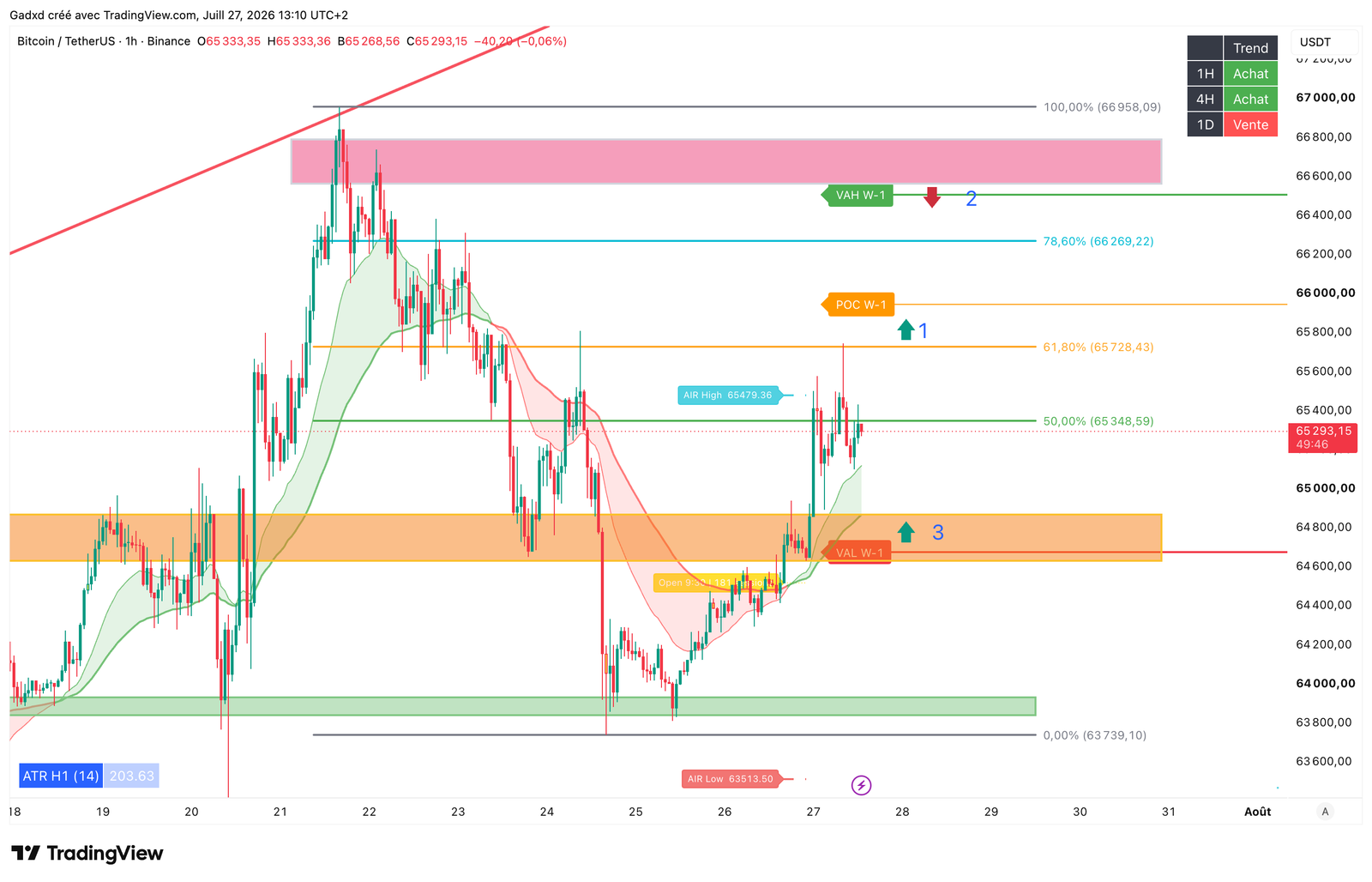
Bitcoin (BTC) is the largest and most liquid cryptocurrency, analysed for daily trading across spot venues that run 24/7 and regulated CME futures, which have traded 24/7 since 29 May 2026. Traders study its intraday range, volume profile and US spot bitcoin ETF flows rather than relying on a fixed market open. Educational analysis only. As of 2026-07-27, our multi-timeframe read is bullish (1H/4H), 1D sell. The full plan — key levels, an educational setup and its invalidation zone — is posted free on Telegram at @dindoutrading every session.
BTC — latest analysis (2026-07-27)
🔒 Full BTC plan — free on Telegram
Key levels, an educational setup and its invalidation zone are posted every session to our channel — free, before the open. Chart and bias above are the preview.
Unlock on Telegram — @dindoutrading →Educational only — not financial advice, not a signal.
How we analyse BTC
We build a volume profile to locate the point of control (POC, the price where most volume traded) and the value-area high and low (VAH/VAL). We compare price to the recent average daily range to judge whether a move is stretched. We watch for liquidity sweeps above prior highs or below prior lows that trap late entries. Finally, we align a multi-timeframe bias across the 1H, 4H and 1D charts before acting.
What moves BTC
- Spot bitcoin ETF flows — US spot bitcoin ETF flows are a primary demand signal; net creations or redemptions can move spot price and set the intraday tone.
- Macro risk-on/off & DXY — Federal Reserve policy, broad risk appetite and US dollar strength shift BTC alongside other risk assets, so a firmer dollar often pressures price.
- Funding & open interest — Perpetual-swap funding rates and futures open interest reveal leverage positioning; crowded funding can precede sharp liquidation-driven moves.
- On-chain supply dynamics — The four-year halving cycle and long-term holder behaviour shape the supply available to the market over medium horizons.
- Regulation & legislation — Regulatory and legislative developments in major jurisdictions can trigger repricing across the whole crypto complex.
- Correlation with tech equities — BTC often correlates with risk-on tech equities such as the Nasdaq-100 (NQ), so US equity sentiment can spill into crypto.
It is the largest and most liquid cryptocurrency, accessible continuously through both spot venues and regulated CME futures. See full BTC contract specs & where to trade.
BTC trading sessions
Bitcoin trades 24/7, so there is no official open or close, but liquidity concentrates during weekday US and European hours, especially the London-New York overlap. Spot volume is typically thinner at weekends, which can widen spreads and produce lower-conviction moves. Intraday traders therefore focus on these high-liquidity windows for cleaner execution.
Typical daily range
Rather than a fixed points target, use Bitcoin's recent average daily range as a realistic reference for how far it tends to move in a session. Among the majors here, Bitcoin is generally the least volatile, with Ethereum typically more volatile and Solana the most. Because crypto trades 24/7, this range measures a rolling 24-hour period, not a cash-session high-low.
Markets correlated with BTC
Bitcoin is the sector leader: Ethereum and Solana typically trade as higher-beta followers (they amplify BTC's direction). BTC also shows periods of positive correlation with risk-on technology equities like the Nasdaq-100 (NQ), so tech-driven risk sentiment frequently carries into crypto.
Previous BTC sessions
2026-07-24
Today's AIR window ≈ 63988.72–65763.72 → the 65200 reclaim and 65763 AIR High are credible; the 66500–66800 supply sits at/above the top edge = ambitious and aligns with the trendline. ATR(1H) ≈ 274 pts (wide) — size accordingly. BTC has lost its daily buy alongside gold — broad de-risking today. Educational only — react at levels, don't anticipate.
2026-07-23
Today's AIR window ≈ 64929–66922 → the 66900–66965 target sits at the top edge (credible but near exhaustion); above 67000 = outside the window = ambitious, and aligns with the trendline / sell zone. ATR(1H) ≈ 296 pts (wide) — size accordingly. Gold and BTC are bid while US indices sit below weekly value. React at levels — don't anticipate.
Get the full BTC plan, free — every session
Key levels, an educational setup and its invalidation zone on BTC and 6 other markets, before the open.
Join @dindoutrading →BTC analysis — FAQ
› Is BTC bullish or bearish today?
As of 2026-07-27, our read on Bitcoin (BTC) is: bullish (1H/4H), 1D sell. We map the levels where price has historically reacted rather than predicting direction — the full multi-timeframe bias and plan are posted free on Telegram each session.
› Is Bitcoin trading 24/7?
Yes. Bitcoin spot markets trade 24 hours a day, 7 days a week, with no daily close. Regulated CME bitcoin and Micro Bitcoin (MBT) futures have also traded 24/7 since 29 May 2026, apart from brief maintenance windows. Liquidity is still deepest during weekday US and European hours.
› What moves the Bitcoin price intraday?
Intraday, Bitcoin is driven mainly by US spot bitcoin ETF flows, Federal Reserve policy and broad risk appetite, and futures positioning such as funding and open interest. Regulatory headlines and large liquidations can also force fast moves, because leverage is common in crypto.
› What is a realistic daily target on BTC?
There is no fixed or guaranteed daily target; that would be a promise no one can make. A more realistic reference is the recent average daily range, which shows how far BTC has typically moved per 24 hours. Traders size expectations to current volatility, not to a set number.
› Is Bitcoin more volatile than stocks?
Bitcoin is generally more volatile than broad equity indices such as the S&P 500. Within the crypto majors it is usually the least volatile of Bitcoin, Ethereum and Solana. Because it trades 24/7, the weekend gaps seen in some futures markets are largely absent from spot.
› BTC vs ETH for day trading?
Both trade 24/7 with deep liquidity. Bitcoin tends to be less volatile and is the sector leader, so it often sets direction. Ethereum is typically higher-beta and can offer wider intraday ranges, at the cost of larger swings. The right choice depends on your risk tolerance and strategy.
› How do CME Bitcoin futures differ from spot?
CME bitcoin futures are regulated, centrally cleared contracts (5 BTC, or 0.10 BTC for Micro MBT) with defined tick values, whereas spot is direct ownership on an exchange. Since 29 May 2026, CME crypto futures trade 24/7, narrowing the old weekend-gap difference versus spot.
› Does Bitcoin have trading sessions like forex?
Not officially. Bitcoin has no exchange open or close, so it lacks formal sessions. In practice, liquidity clusters around weekday Asian, European and US hours, and the London-New York overlap is often the most active window for intraday traders.
› Where can I get free BTC analysis?
Free daily Bitcoin analysis — bias, key levels and one educational setup — is published every session on Telegram at @dindoutrading. This page mirrors the latest read; the full plan is on the channel.
› Does Dindou Trading give BTC signals?
No. Everything is educational analysis of price structure — we never tell anyone what to buy or sell, and there is no paid signal service.