Solana (SOL)
It is a high-throughput layer-1 asset with an active spot market and, since March 2025, regulated CME futures and micro futures. It trades on spot exchanges and CME, tracking SOL, the native asset of the Solana blockchain, and is most active during weekday us and european hours; spot volume is typically thinner at weekends. We publish free educational analysis on SOL before each session — bias, key levels and one setup — and compare the brokers and prop firms that give access to it.
Latest SOL analysis
All markets →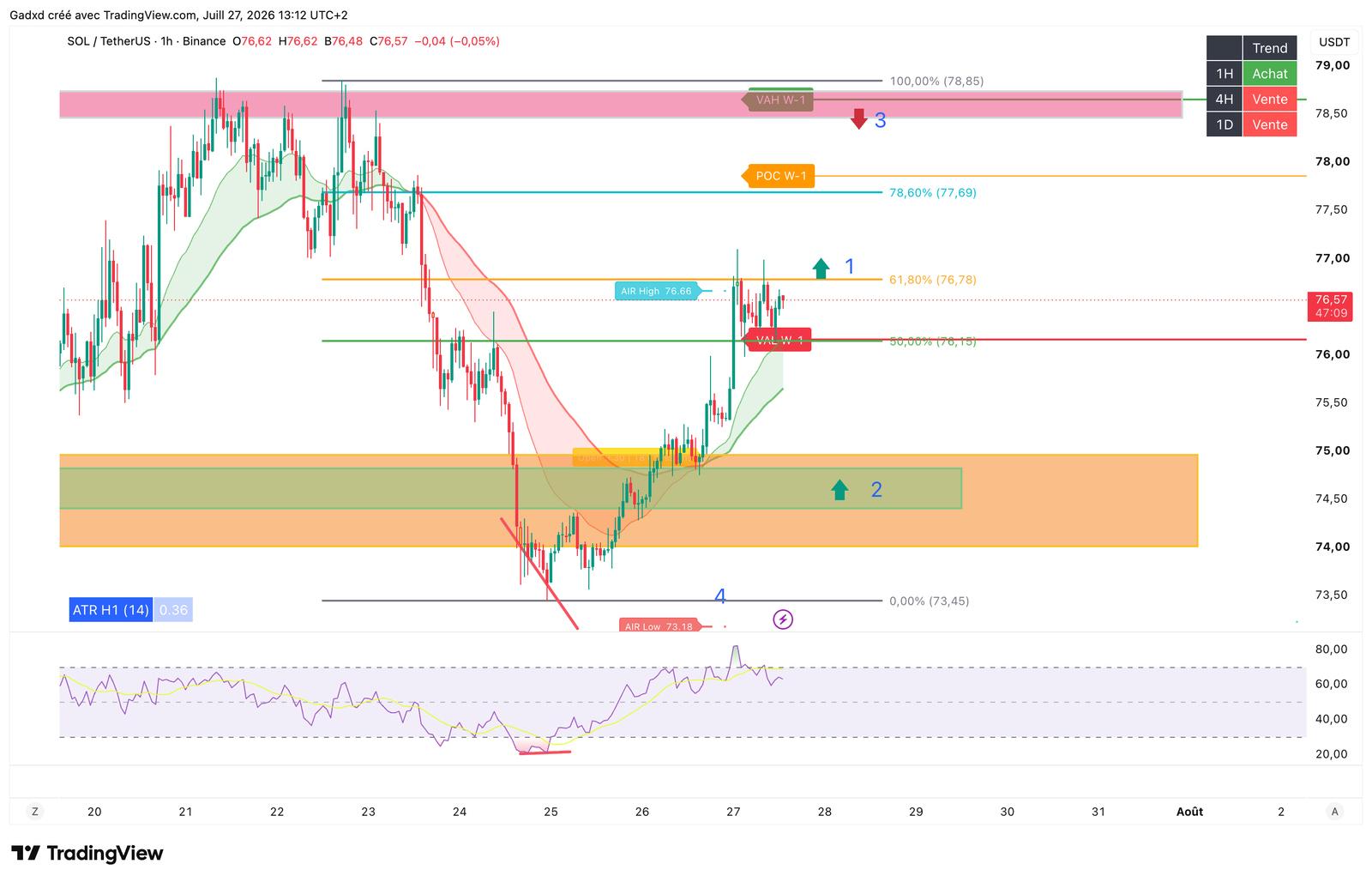
2026-07-27
⚪ Neutral- 🟢 Long scenario at 76.66–76.78
- 🟢 Long scenario at 74.50–75.00
- 🔴 Short scenario at 78.50–78.85
Educational scenarios showing where price has reacted — not financial advice, not a signal, and not a recommendation to trade.
SOL contract specifications
| Ticker | SOL |
|---|---|
| Asset class | Crypto |
| Traded on | Spot crypto exchanges, CFDs where permitted, and regulated CME futures |
| Underlying | SOL, the native asset of the Solana blockchain |
| Contract size | CME SOL futures: 500 SOL · Micro (MSL): 25 SOL |
| Tick size | $0.05 per SOL (CME outright) |
| Tick value | $25.00 (SOL) · $1.25 (MSL) |
| Smaller contract | MSL — Micro SOL futures (CME), 25 SOL |
| Trading hours | Spot: 24/7. CME SOL/MSL futures: 24/7 since 29 May 2026, apart from brief maintenance windows |
| Most active | During weekday US and European hours; spot volume is typically thinner at weekends |
Contract specifications are set by the exchange and can change — confirm the current specs on CME Group’s own site. Margin requirements are set by your broker and are deliberately not listed here.
What moves SOL
- Solana network activity, including DEX volume and application usage
- Network outage or reliability incidents
- Spot Solana ETF and institutional product flows
- Broad crypto risk sentiment, largely correlated with bitcoin
Where to trade SOL
Advertising disclosure: Some links on this page are affiliate links. If you open an account through them we may earn a commission at no extra cost to you. Providers we list are ones we have — or are seeking — an affiliate relationship with, so this is not a survey of the whole market. Commission never affects our editorial rankings, which are our own assessment — see how we rate. Trading involves significant risk of loss.
Risk warning: CFDs and leveraged products carry a high risk of rapid loss. The majority of retail investor accounts lose money trading them. Futures brokers are priced by commission per contract, not spreads, so “pips” and “commission-based” are not directly comparable — and a 0.0-pip raw spread never includes the commission charged on top. Minimum deposits, leverage caps, product availability and investor protection depend on the entity that serves your country, and several brokers listed do not accept clients from every jurisdiction. Educational information only — not financial advice.
Brokers offering SOL
About prop-firm evaluations: these are simulated/demo trading environments. Most participants do not pass the evaluation, challenge fees are typically non-refundable, and passing does not guarantee a payout. Educational information only — not financial advice.
Prop firms offering SOL
Tracked payouts are all-time totals confirmed on-chain by Payout Junction, which covers only firms paying via Rise wallets — an absent figure does not mean a firm has not paid. Totals are aggregate across all traders, not an indication of individual outcomes.
Compare all prop firms →Crypto-native venues for SOL
These are decentralised, non-custodial venues — not brokers. They are listed separately because ranking them against a regulated broker on deposit minimums, spreads or regulation would compare two different things.
Understand the trade-off: with self-custody your funds stay in your own wallet, so no firm can freeze or lose them. In exchange there is no financial regulator, no compensation scheme and no ombudsman, and you take on smart-contract and wallet risk instead. A mistaken transaction or a lost key cannot be reversed by anyone. Leverage on perpetuals is often far higher than a regulated broker may offer retail clients, and it magnifies losses at the same rate as gains.
Self-custody perpetuals DEX covering crypto, stock and commodity markets.
Editorial rating
Learn how SOL trades
How to Trade Solana (SOL): A 2026 Guide
A structured, educational walkthrough of how to trade Solana (SOL) — what the asset is, why traders track it, the facts that matter, and a repeatable analytical framework built on volume profile, key levels and range measurement.
Read the full guide →
SOL — frequently asked questions
› Where can I trade SOL?
You need an account with a broker or a prop firm that offers Solana. We list 6 brokers and 10 prop firms covering this market, compared on cost, regulation and client eligibility.
› What moves SOL?
Solana network activity, including DEX volume and application usage, Network outage or reliability incidents, Spot Solana ETF and institutional product flows, Broad crypto risk sentiment, largely correlated with bitcoin. Our daily analysis maps the levels where price has historically reacted, rather than predicting direction.
› Does Dindou Trading give SOL signals?
No. We publish educational analysis — bias, key levels and one educational setup per session. We never tell anyone what to buy or sell, and there is no signal service.
› Is SOL analysis free?
Yes. SOL is one of the 7 markets we break down before each session, published free on Telegram at @dindoutrading and mirrored on this site.
Free SOL analysis, every session
Bias, key levels and one educational setup — before the open.
Join @dindoutrading →